Stop Hiring Humans for Tasks Handoff.AI Can Automate Forever
From Clipboard Chaos to Cash Flow Clarity: Why Handoff.AI Belongs in Your Stack
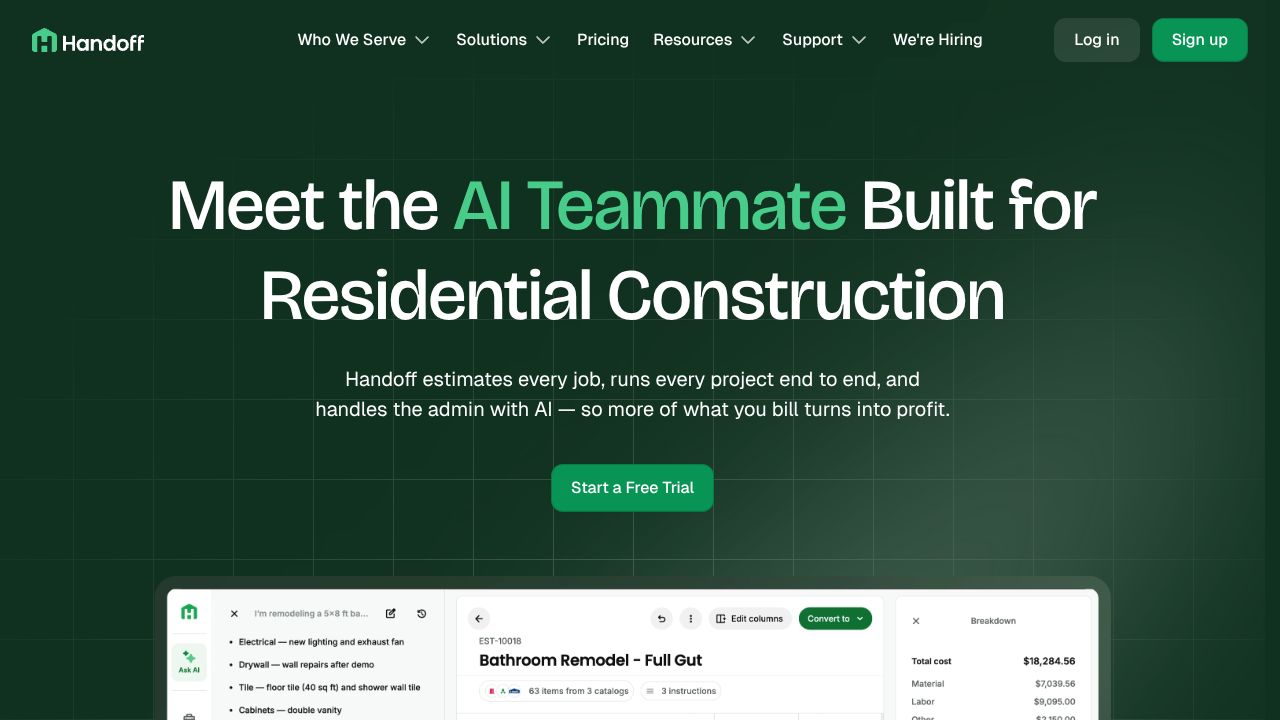
You know the drill—voice notes from site walks, supplier prices that change mid-bid, proposals in one system and invoicing in another. Errors creep in, margins erode, and slow estimates cost you wins. Handoff.AI is a vertical AI platform that compresses the entire contractor workflow—from lead to estimate to payment—into one system. It matters because speed, accuracy, and cash conversion now differentiate winners. Bottom line: it replaces scattered tools with a measurable path to higher close rates and steadier margins.
The Business Case
For residential contractor-led startups, Handoff.AI’s value lies in cycle-time compression and margin discipline. The platform generates instant AI estimates from text, PDFs, or voice notes; transcribes AI site walkthroughs; pulls real-time local pricing (e.g., Home Depot) to anchor estimates; and unifies CRM, proposals, invoicing, and project management for a single source of truth. Our analysis shows three drivers of ROI:
- ▸ Faster quotes raise win rates: Industry benchmarks consistently show speed-to-quote influences close rates; moving from 24–48 hours to near-instant estimates can lift conversion by 5–15% in competitive residential work.
- ▸ Real-time pricing limits slippage: Tethering estimates to local supplier data reduces surprises that typically compress gross margins late in projects.
- ▸ Tool consolidation reduces TCO: At $149/month (with a 7-day free trial), Handoff.AI can replace multiple point solutions (estimating, proposal, CRM, invoicing, basic PM). Even a conservative $200–$350/month in avoided licenses plus 10–20 admin hours saved can yield payback in weeks.
Modeled impact (assumptions disclosed): If a 10-person firm issues 30 quotes/month, saving 60 minutes/quote equals ~30 hours saved. At a $60/hour loaded rate, that’s $1,800/month in time value. A 5% lift in win rate on $30K average monthly awarded work adds ~$1.5K/month. Combined, the platform clears its cost several times over.
Key Strategic Benefits
- ▸
Operational Efficiency:
- ▸ AI-driven estimates from text, PDFs, or voice notes reduce handoffs and rework; AI site walkthroughs convert raw observations into structured scopes and line items.
- ▸ Unified CRM-to-invoice flow eliminates context switching and data duplication, improving task adherence and reducing drop-offs between sales and production.
- ▸
Cost Impact:
- ▸ Real-time local supplier pricing narrows estimate-to-actual variance, protecting 1–3 percentage points of margin on materials-heavy jobs.
- ▸ Consolidating disparate tools into a single subscription cuts overlapping spend and reduces integration maintenance overhead.
- ▸
Scalability:
- ▸ Standardized scopes and templates create repeatability across crews, enabling faster onboarding and consistent pricing logic as you add territories.
- ▸ Input flexibility (voice, text, PDFs) captures field knowledge at scale, minimizing the bottleneck of a single “chief estimator.”
- ▸
Risk Factors:
- ▸ Estimate quality depends on input accuracy; leaders should institute standardized voice memo protocols and spot-check early outputs.
- ▸ Local pricing coverage can vary; confirm supplier linkages in each service area to avoid gaps.
- ▸ Change management is nontrivial—field adoption of voice-driven workflows requires brief, focused training and clear SOPs.
Implementation Considerations
Plan a two-week rollout anchored by a 7-day trial. Week 1: import contacts via CSV, define 5–10 common templates (kitchen, bath, roof repair), connect supplier accounts, and establish a voice-memo SOP (location, measurements, materials, constraints). Identify KPIs: quote cycle time, estimate-to-actual variance, close rate, and admin hours per job. Run side-by-side on 5 live leads: generate AI estimates, validate line items against supplier feeds, and route accepted proposals to digital invoicing and customer financing.
Week 2: expand to all new leads; conduct daily 15-minute standups for estimator/PM feedback; lock a “definition of done” for scopes. Ensure role-based access and audit trails for approvals above a margin threshold. Integration lift is modest given Handoff.AI’s built-in CRM/invoicing; if you maintain parallel finance systems, map invoice exports and reconciliation steps. Success criteria: sub-24-hour quoting on 90% of leads, <2% material price drift vs. estimate on test jobs, and 25–50% reduction in administrative time per estimate.
Competitive Landscape
While Origami Agents excels at customizable AI agents for sales logic and complex outreach workflows, Handoff.AI is better suited for contractors who need end-to-end estimating tied to real-time materials pricing and field-friendly voice inputs. Creatio offers a robust low-code platform to automate generalized CRM and operations; for organizations seeking deep customization across multiple departments, Creatio may out-flex Handoff.AI. However, Handoff’s verticalized, out-of-the-box flows deliver faster time-to-value for residential contracting. HeyReach leads in multi-channel prospecting (LinkedIn + email) and list orchestration; pair it with Handoff.AI if top-of-funnel outbound is your constraint, acknowledging that Handoff focuses on post-lead execution from estimate to payment.
Recommendation
Adopt Handoff.AI via a structured pilot. Action items: appoint an estimating “product owner”; codify a voice-memo SOP; build 10 common estimate templates; and run a 10-lead A/B test (legacy vs. Handoff) tracking cycle time, win rate, estimate-to-actual variance, and admin hours. If Handoff reduces quoting time by ≥50% and lifts win rate by ≥5% while stabilizing margins, standardize it across teams at $149/month and redeploy saved hours to higher-value sales and project oversight.
Spark. Ignite. Launch.