Lorikeet Security: A Deep Dive for Startups
Penetration testing isn’t just a report you print — it’s a program you run
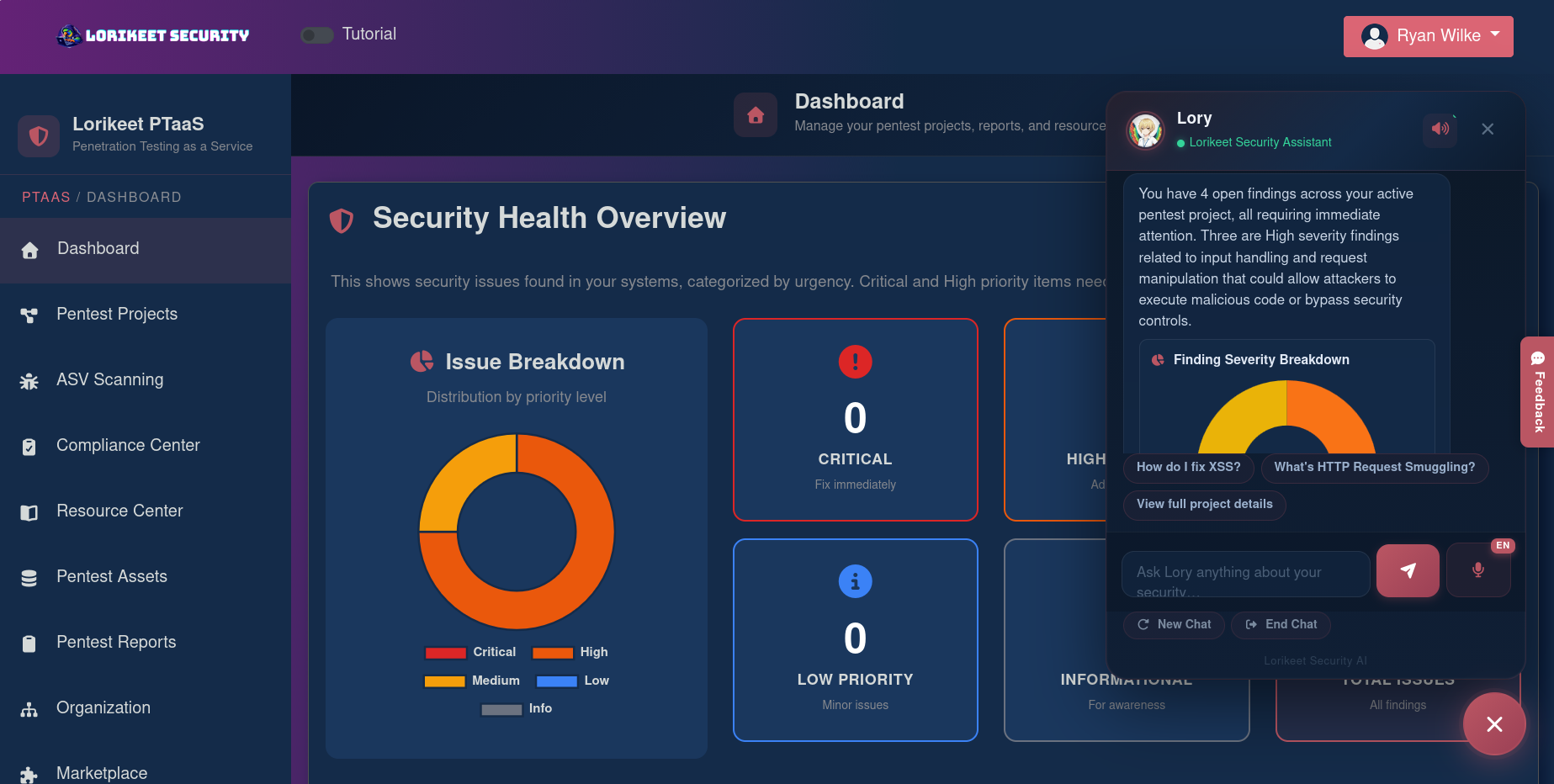
Most vendors still treat pentests as a discrete deliverable: a PDF and a call. Lorikeet Security takes the contrarian position that offensive security must be continuous, contextual, and integrated into the same workflows that engineers and auditors use. The platform mixes 100% manual pentesting across applications, APIs, infrastructure and specialized domains with continuous attack-surface monitoring, compliance automation, and an AI assistant (Lory) trained on nearly 2,000 vulnerability entries — all surfaced in a real-time client portal. The result is less “one-off audit” and more continuous security program delivered through a single pane of glass, designed for startups scaling into regulated or cloud-native environments.
Architecture & Design Principles
Lorikeet’s architecture centers on a platform layer that abstracts engagements, telemetry, and remediation state. Key design principles include:
- ▸ Separation of human analysis and telemetry — manual researcher findings are surfaced through structured data models (repro steps, exploit artifacts, remediation blocks), not raw scanner output.
- ▸ Real-time state and event streaming — the portal updates engagements live (likely implemented with event-driven microservices and WebSocket or SSE channels) so stakeholders see progress, retest results, and alerts without PDF lag.
- ▸ Modular monitoring pipelines — continuous attack-surface monitoring runs 24/7, combining asset discovery, credentialed checks, and external observability (cert transparency, exposed endpoints, API schema fuzzing) to reduce blind spots.
- ▸ Compliance-first data capture — findings map to control frameworks (SOC 2, PCI, ISO 27001, etc.) so evidence and reports are audit-ready, enabling a single engagement to feed both security remediation and attestation workflows.
These choices prioritize human validation (zero automated false-positive policy) and enterprise orchestration over pure automation.
Feature Breakdown
Core Capabilities
- ▸ Penetration testing (app + infra): Manual assessments cover web apps, REST/GraphQL/SOAP APIs, mobile/desktop clients, cloud (AWS/Azure/GCP), AD, containers/Kubernetes, wireless, and networks. Use case: startup preparing for Series B hires Lorikeet to validate API auth flows and Kubernetes RBAC, with step-by-step developer remediation.
- ▸ Continuous attack surface monitoring: 24/7 external and internal monitoring identifies newly exposed services, certificate/TTL changes, and suspicious asset fingerprint drift. Use case: DevOps teams catch a forgotten staging endpoint exposed after a CI rollback.
- ▸ Compliance automation & attestations: Maps findings to SOC 2, PCI-DSS, ISO 27001, HIPAA, and many others; partnered integrations with Vanta and Drata and attestation via Accorp Partners CPA. Use case: security lead runs pentest + compliance sprint to combine remediation evidence into an audit package.
- ▸ Security awareness & CTFs: Phishing sims, interactive courses, analytics and Parrot CTFs to operationalize human risk reduction. Use case: HR and security coordinate phishing campaigns tied to measurable training completion and campaign metrics.
Integration Ecosystem
Lorikeet exposes an integration surface that supports SIEM/SOAR ingestion, ticketing (Jira/Trello), and compliance connectors through partners (Vanta, Drata). The platform’s live portal and AI assistant imply RESTful APIs and webhooks to automate retests and ticket creation; SSO/SAML and role-based access controls are standard enterprise expectations for linking to identity providers and audit logging.
Security & Compliance
Data handling emphasizes audit-readiness: findings include remediation steps for developers and auditors, retesting is free to verify fixes, and coverage spans SOC 2, PCI, ISO 27001, HIPAA, CMMC, GDPR and more. Partnerships with Vanta/Drata and Accorp Partners CPA close the loop from testing to attestation, making Lorikeet enterprise-ready for regulated customers.
Performance Considerations
Continuous monitoring trade-offs are explicit: to maintain 24/7 coverage without excessive noise, cadence and crawl breadth must be tuned to rate limits and client risk profiles. Manual pentests increase time-to-completion compared with automated scans but deliver near-zero false positives and reliable remediation verification. Portal responsiveness will hinge on event-store performance and the efficiency of telemetry pipelines.
How It Compares Technically
While Flowtriq excels at instantaneous DDoS detection and automated mitigation — prioritizing network-layer availability with near-instant rule pushes — Lorikeet Security is better suited for comprehensive offensive security programs that combine manual human analysis, compliance attestations, and continuous asset monitoring. Pricing and procurement differ: Flowtriq’s value accrues to teams needing predictable, throughput-based DDoS protection; Lorikeet’s engagement-based pricing favors startups and enterprises that require bespoke testing breadth, retesting, and audit evidence. In ease-of-use, Flowtriq offers plug-and-play availability protection; Lorikeet requires orchestration with engineering and audit teams but returns higher signal-to-noise and compliance utility.
Developer Experience
Documentation appears focused on actionable remediation and auditor-ready artifacts rather than raw scanner logs — a positive for engineering handoff. The platform integrates with ticketing and compliance tooling; the presence of an AI assistant trained on real findings accelerates remediation triage. For teams that want SDKs and CI/CD hooks, Lorikeet’s APIs and webhooks (implied by the real-time portal and integrations) are where automation meets human verification.
Technical Verdict
Lorikeet’s strengths are breadth of manual coverage, continuous attack-surface monitoring, and compliance orchestration — especially valuable for startups moving from early product-market fit into regulated growth phases. Limitations include longer engagement timelines compared with automated-only services and higher integration overhead to realize audit-ready workflows. Ideal use cases: startups and mid-market companies that need verified, low–false-positive pentests + compliance evidence; not the right fit if your sole concern is automated DDoS mitigation or an inline WAF. The data shows that combining human-led testing with continuous monitoring materially reduces remediation churn — and that’s the core of Lorikeet’s value proposition.